Mozart’s vocal music was some of the earliest that made me fall in love with opera.
But Mitridate, re di Ponto was just a name to me — or not even that — when in the late 1970s, I discovered what was then a new recording on Deutsche Grammophon, conducted by Leopold Hager. The brio and virtuosity of the arias was exhilarating. That record also served as a valuable introduction to some singers who were then still early in their ascending stardom.
Three excerpts particularly dazzled me, and never left the turntable (yes, this was the LP era) without being repeated several times. They are Venga pur, minaci e frema sung by Agnes Baltsa; Al destin che la minaccia, sung by Arleen Auger; and Lungi da te, mio bene sung by Edita Gruberova. (Through the magic of YouTube, I can now share them with you!)
Since then, Mitridate has, rather surprisingly, found its way to stagings by several companies, now including Opera Philadelphia. Indeed, one of the excerpts above — Lungi da te, ravishingly sung by Meredith Wohlgemuth — is a major highlight here.
Yet the conclusion I reached after watching Philadelphia’s sometimes imaginative but often gimmicky and awkwardly staged production, is that sampling this opera seria in small bites is more satisfying than sitting through the whole work.
This is hardly surprising. Mitridate was composed in 1770, when Mozart was 14. (Let that sink in.) That the arias are as elegant and brilliant as they are is miraculous, but we can hardly expect that the child composer would also have a sophisticated sense of dramatic structure. Ten years later, he would revisit the opera seria form with Idomeneo; and another ten years after that, with La Clemenza di Tito. Each of these is, understandably, light years beyond Mitridate in terms of both musical variety and theatricality.
The subject here, as with many operas seria, is literally ancient history: a pre-Christian turf war between the rival kingdoms of Rome and Pontus. (One need not be a historian to know who emerged victorious.)
But the historical story doesn’t seem of much interest to Mozart and his librettist, the fabulously named Vittorio Amedeo Cigna-Santi.
Rather, their focus is more on family squabbles. Mitridate of Pontus has disappeared, presumed killed in battle. (Spoiler alert: he wasn’t.) In his absence Farnace and Sifare, his two sons are at odds, fighting over both political allegiances and romance (both are in love with Mitridate’s fiancé, Aspasia). Let the games begin.
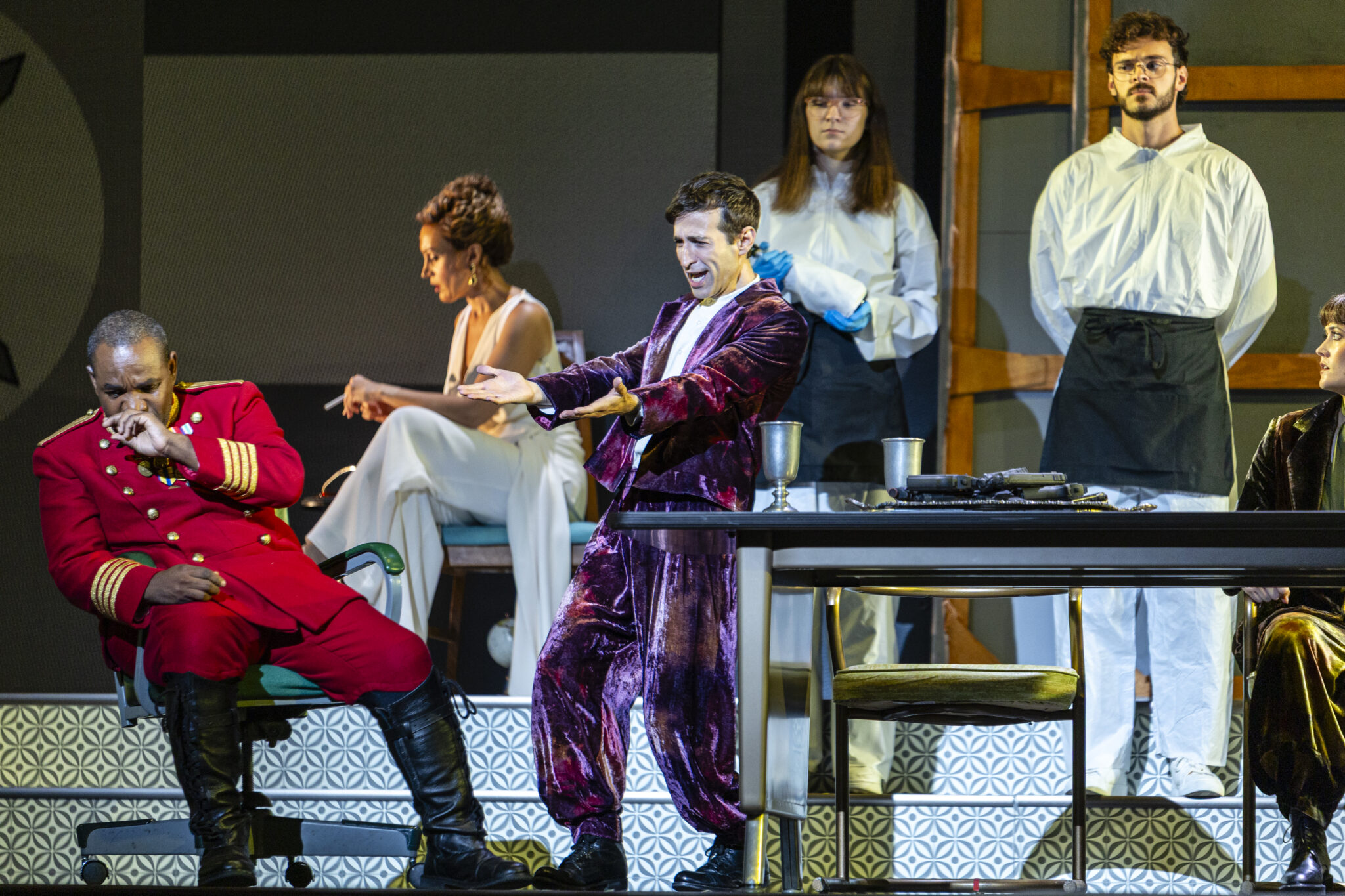
If the politics didn’t much grab Mozart and Cigna-Santi, they seem even less interesting to this production’s director, Emma Griffin. The stage is festooned with a backdrop of flag-like banners in cartoonishly bright colors, which seems designed to signal from the start that while we’re looking at a world at war, we’re not going to take it seriously. (The wildly overbusy production is designed by Kaye Voyce, who is also responsible for a mixed bag of costumes, ranging from chic—an elegant white jump suit for Aspasia—to gauche, with no regard to period or line.)
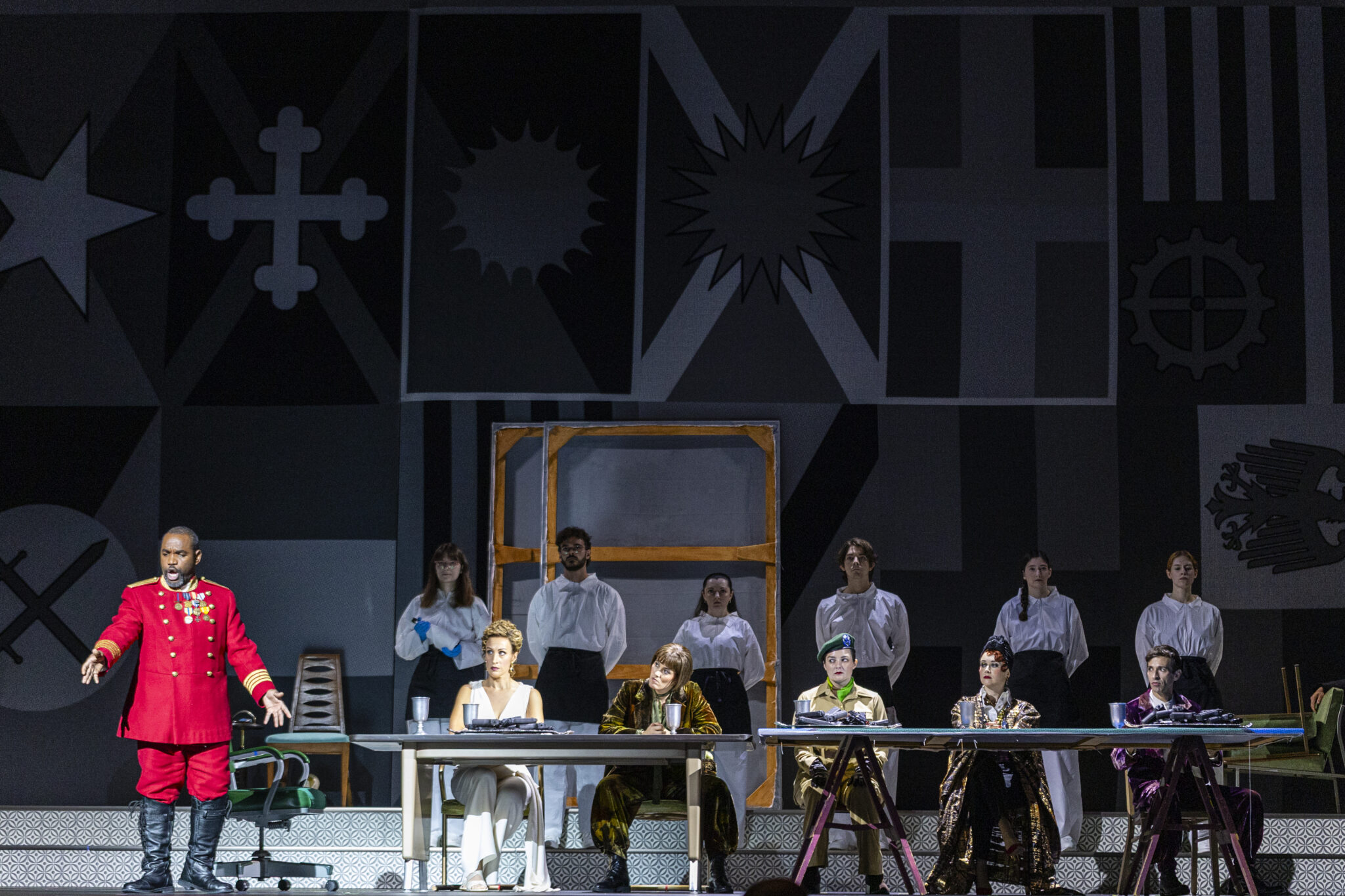
As has now become a fairly standard interpretive choice in reviving operas seria, the plot and action are mined for humor, even camp. Much furniture is kicked and thrown; globes are everywhere, but exist only to be rolled around or played with.
To be fair, it’s tricky to know just what to do with Mitridate and works like it. While they are about complicated relationships, the action unfolds through solo arias — a single duet here is the only variant in three-plus hours of music. Actual musical conversation is virtually non-existent.
My personal feeling about successfully staging opera seria is that less is more. The beauty and grandeur of the music provide their own drama; a surfeit of action merely distracts and coarsens these works. But clearly, I’m losing this battle.
In any case, what audiences will likely care about here is the music-making— and on that account we’re mostly on firmer ground. Lawrence Brownlee wins the day as Mitridate, his tenor in glowing form (astonishingly, he sounds as fresh here as when he won the Met competition 25 years ago), and his acting is sincere and direct. The very lowest notes test him, but everything else is handled superbly.
As the desired Aspasia, Brenda Rae cuts a suitably glamorous figure and acts very well, especially in the more lyric moments, which also work best for her vocally. The punishingly difficult coloratura isn’t always ideally projected.
As noted earlier, soprano Meredith Wohlgemuth (Sifare) offers consistently beautiful tone and elegant line—for my money, she’s the MVP here.
In the smaller role of Ismene, another good soprano, Nola Richardson, impresses with bell-like tonal purity and good florid work. Tenor Minghao Lee (Marzio) is challenged by a fiercely difficult aria that comes near the operas end, but he copes heroically if not entirely accurately. Sarah Coit does well in the small role of Arbace. ( I should also say, though, that in Mozart’s score virtually every aria calls for trills, and they are in short supply here.)
This leaves countertenor Anthony Roth Costanzo, who is of course also Opera Philadelphia’s General Director. In the showy alto role of Farnace, ARC (as he’s universally known) gives a perplexing performance… actually, what feel almost like two performances.
The early scenes are a showcase of petulant Boy King mannerisms and too much schtick. The voice, under considerable pressure in the florid passages, is accurate and well-projected, but tonally unpleasant.
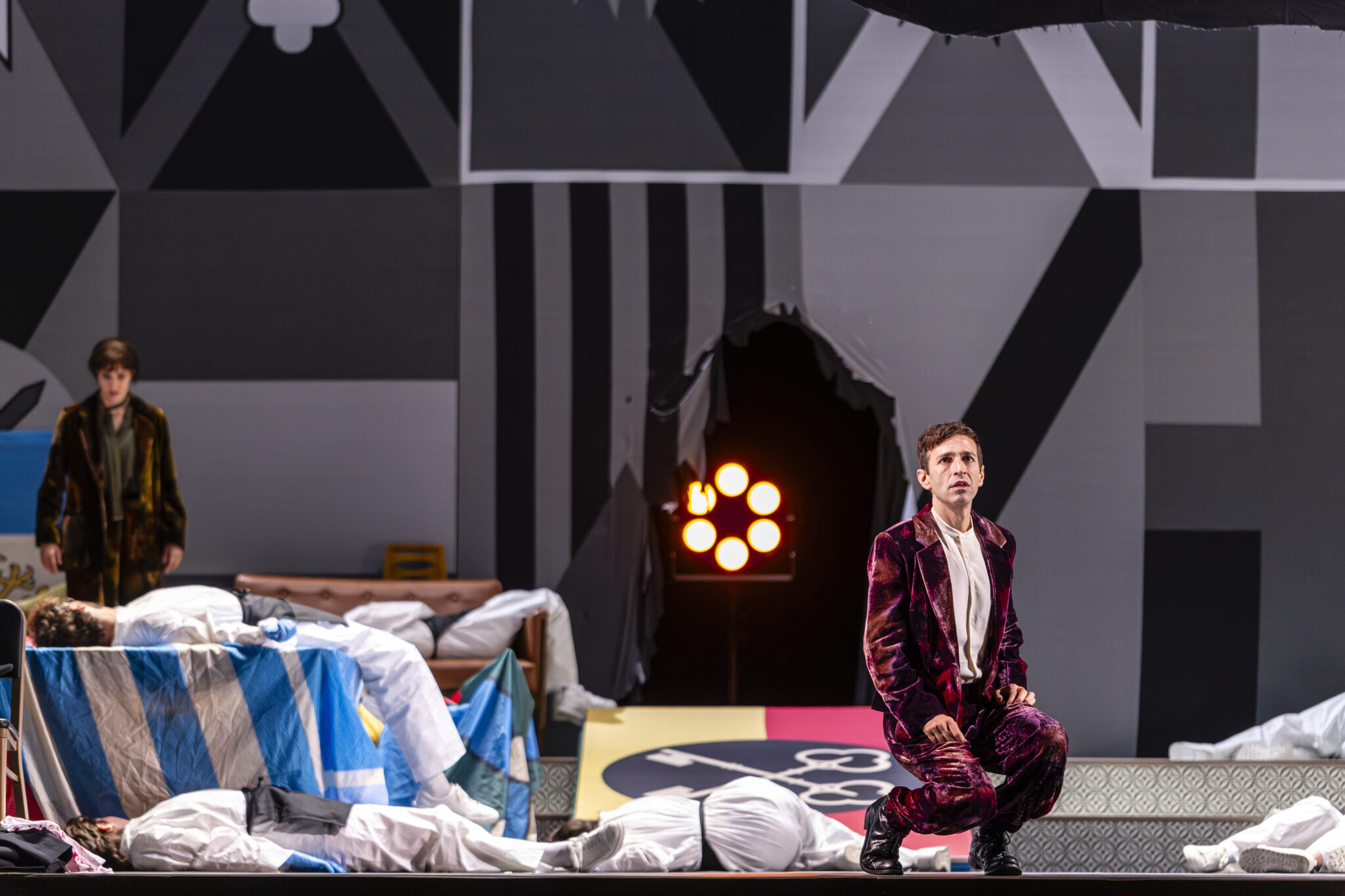
But stick around: something magical happens late in the show. Costanzo’s final scene is transformed. His acting is powerfully simple and direct, and the voice — no longer pushed but allowed to float quietly above a light orchestral accompaniment — has an unearthly beauty. (Corrado Rovaris and the Orchestra are especially good here too.)
The whole of this final scene that is by far the most effective moment in this production. The winky glibness gives way to something grander and more somber, including a powerful coup de theatre that sends us home with a lot to think about.
Proof, too, that opera seria works best when taken seriously.
Categories: Music, PARTERRE BOX, Philadelphia


