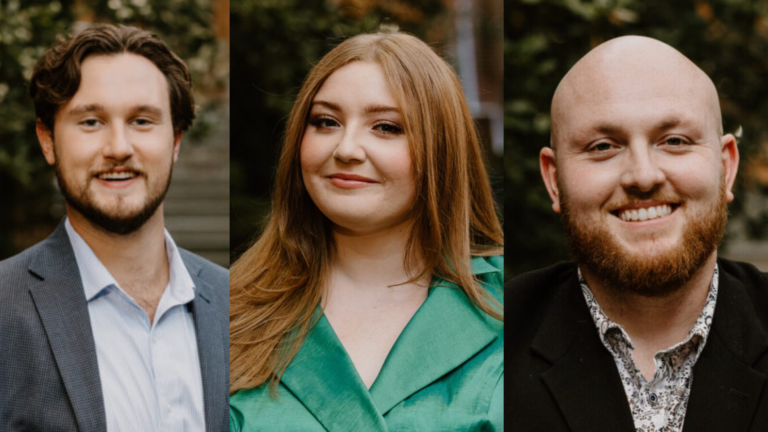
It’s been several years since I attended AVA—Philadelphia’s Academy of Vocal Arts—and I enjoyed the reacquaintance. Their Giargiari Bel Canto Competition is always a great way to hear many of the resident artists, and this year was a bumper crop, with 16 participants! The larger number meant limiting each singer to a single aria, but most took advantage with substantial excerpts.
Here’s a run-down of some highlights.
The Prize Winners (in reverse order):
Interestingly, it broke down to two tenors and two mezzos. (One of the judges was Dolora Zajick, so she certainly knows her mezzos!) A tie for Second Place Prize made for a total of four singers who placed:
Third Place Prize: Katherine Dobbs (mezzo-soprano). Dobbs has a strong lyric mezzo with significant power and weight behind it. She chose “Parto, parto” from La Clemenza di Tito as her solo, and it showed off her wide range and lovely tone. Efforts to infuse the piece with drama were sometimes distracting and done at the expense of line, and her triplets weren’t ideally precise. But it’s a good instrument.
Second Place Prize: Joshua Berg (tenor) / Matthew Sink (tenor). The tenors who tied for Second Place are an interesting contrast. Berg’s lovely lyric tenor and good sense of line will serve well in lyric bel canto roles, and especially in Mozart: his competition solo, “Dies Bildnis ist bezaubernd schon” from Die Zauberflöte, is deceptively difficult, and he did it with grace and polish. Sink is a true dramatic tenor in the making—his “Vesti la giubba” rang out powerfully in the house with a color and emotionality that made one think of Richard Tucker. (“This is the kind of voice we need,” whispered my husband, shortly after Sink started to sing.) Additional polish is needed, but it’s a very exciting sound.
First Place Prize: Dawson Franzino (mezzo-soprano). Franzino also won the Audience Prize, and it’s easy to see and hear why. It’s a sit-up-and-take-notice voice — a true mezzo with a columnar evenness of tone throughout a large range. La Cenerentola’s “Nacqui all’affanno… Non più mesta” showed off all of this impressively. I found some of the vocal ornaments awkward, and her Cenerentola here seemed more virtuosa than charmeuse. I could imagine that some of the more dramatic coloratura mezzo repertoire might suit her better (Arsace in Semiramide, perhaps), and she certainly seems like a future Carmen. Whatever path Franzino takes, I predict she’ll find success.
Two Singers I Would Have Awarded Prizes:
Ryan Wornall (bass): A true bass is rare, and the tall, imposing Wornall is just that. It’s a terrific instrument, full of color and presence. His solo, “Vous qui faites l’endormie” from Faust is relatively short and showy. As yet, he doesn’t quite have the effortless Gallic charm to fully pull off the piece, but the tricky laughing passages, which often feel forced, were superbly executed.
Beautiful Sheriff (soprano): For my money, Sheriff’s “Ain’t It a Pretty Night” from Carlisle Floyd’s Susannah was the outstanding performance of the night. Upper register phrases were ravishingly lovely… but at least as important, Sheriff—alone among the group—seemed to live within the music, subtly and effortlessly at one with the character. There were some issues—her diction was occasionally occluded, and some of the lower phrases didn’t register as well as they might. But there’s something special about Sheriff—a small woman with a great talent. As Helena famously says of Hermia in A Midsummer Night’s Dream: “And though she be little, she is fierce.”
A few general observations:
- This seems like an unusually big-voiced group—in the intimate Perelman Theater, sometimes performances felt almost uncomfortably loud. Big voices are a good thing in opera, of course—but here, in almost every case, I wished for more mezzo-forte and piano singing.
- As with the push for volume, many of the singers tried too hard to “act” their arias. Those who made the best impression as mature artists often moved and gestured the least, letting their vocal performances provide the drama. Best in this regard were Sheriff and Berg (see above), as well as mezzo Maiya Williams and baritone Jacob Hines.
- With 16 singers, clearly limiting each to a single aria was necessary, but I hope in the future they go back to two. Often the chance to sing twice helps dispel a singer’s nerves, and a second aria, especially if it’s in a different style, really gives a fuller picture.
All the participating singers were accompanied by AVA Music Director and Pianist Danielle Orlando, who received a huge ovation at the close of the evening.
And that’s a wrap for me, though I’m looking forward to hearing these singers and more in at least some of the AVA operas this year (they include L’ Elisir d’Amore, Il Trovatore, and a double bill of Il Tabarro with Gianni Schicchi.
Categories: Criticism, Music, PARTERRE BOX, Philadelphia


