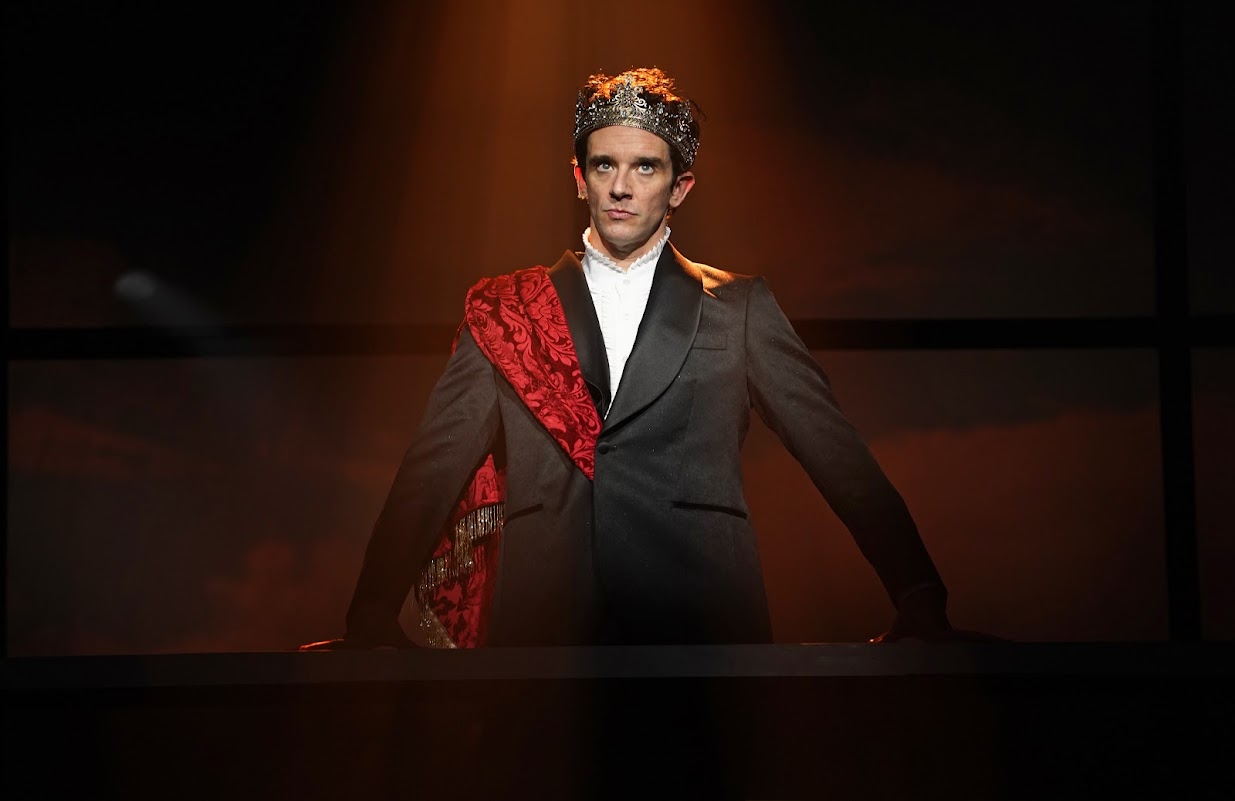
Red Bull Theater’s adaptation of Richard II turns one of Shakespeare’s more sedate historical tragedies into a relentlessly pulsating seriocomedy. Transporting the action from 14th-century England to the gilded go-go 1980s, adapter and director Craig Baldwin offers an intermittently entertaining and frequently frustrating portrait of an aloof monarch whose unavoidable hubris presages his inevitable downfall. Their road to hell is paved with party drugs and strobe lights.
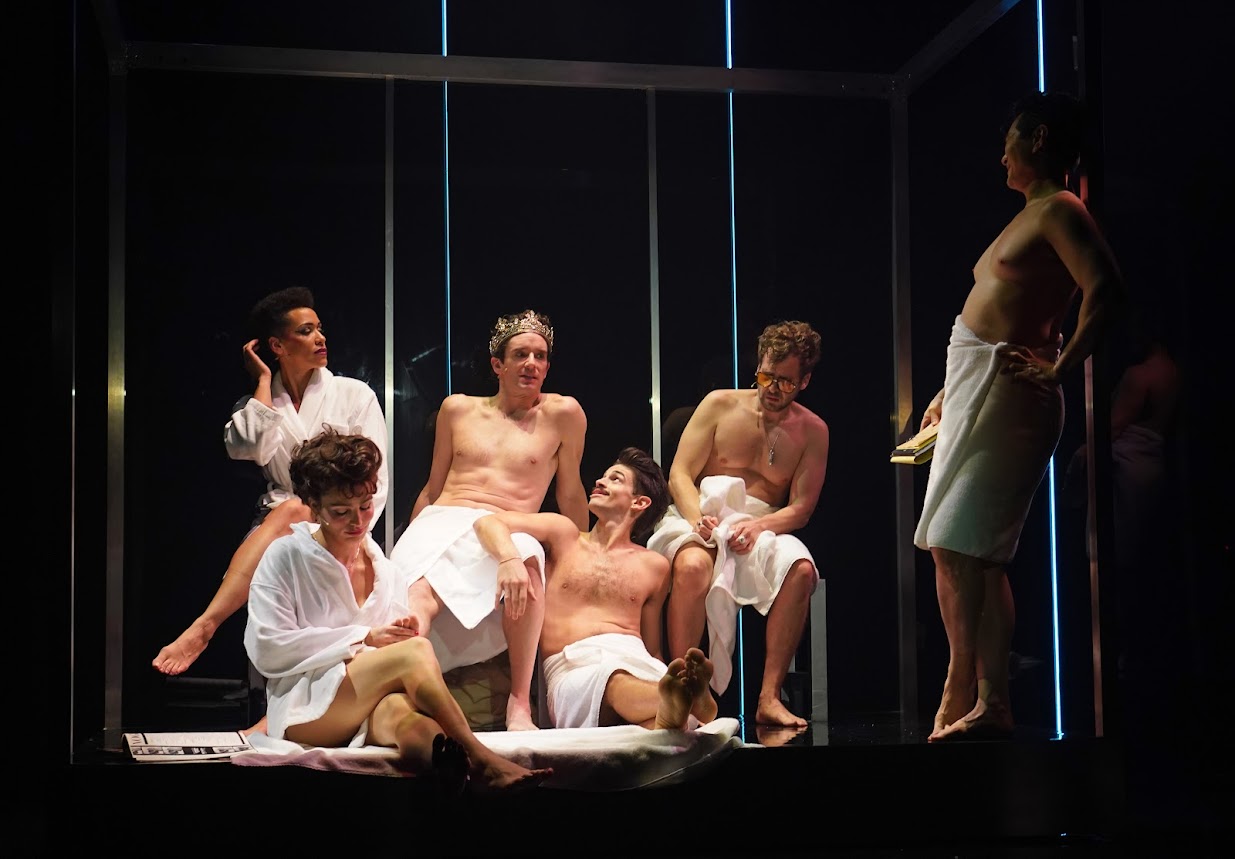
We first meet Richard (Michael Urie), crouched and half-naked, in a darkness-plunged glass cage. In quick succession, that same prison where he festers becomes a court and a club, underlining a hedonistic streak beneath the monarch’s malevolence. (Arnulfo Maldonado designed the set, with lighting from Jeanette Oi-Suk Yew.) The testy infighting that leads to Richard abdicating his throne to Henry Bolingbroke (Grantham Coleman) takes place to the strain of pulsating music and an unabashedly kitschy aesthetic.
Baldwin and Urie present a Richard who is highly strung and unapologetically queer. This is hardly a new take, but Urie offers interesting layers in his characterization, moving beyond simply presenting Richard as a gay villain. He is a conflicted soul, passionate toward both his Queen (Lux Pascal) and his male lover Aumerle (David Mattar Merten), and perhaps a touch jealous of Bolingbroke’s virile, heterosexual masculinity. Although Urie’s physicality and textual delivery veer toward camp at times, he manages a real portrait of a real person beneath the outsize mannerisms.
Typical of Red Bull productions, the supporting cast is chock-a-block with fine classical actors. Especially effective here are Ron Canada as a world-weary John of Gaunt and Kathryn Meisle as a gender-flipped Duchess of York, her helmeted hair and power suit evoking Margaret Thatcher. (Rodrigo Muñoz designed the costumes.) Meisle is especially effective in balancing her divided loyalty as a patriot, shifting her allegiance from Richard to her relative Bolingbroke in a believable hair-trigger moment.
Although the period updating occasionally feels more like an affectation than a fully realized dramaturgical idea, it also serves to make one of Shakespeare’s thornier plays more accessible and immediate to a modern audience. The company, led by Urie, also gives the kind of performances that invite the audience to lean in and be absorbed in the Bard’s language – much of which Baldwin retains.
In the play’s most famous moment, Richard implores his confidantes to “sit upon the ground and tell sad stories about the death of kings.” This Richard II shows that tragedy can be just as gruesome when set to a club beat.