X marks the spot in Rossini’s Il Viaggio a Reims. No, not Elon Musk’s neutered platform, this is France’s King Charles X (the 10th), whose 1825 coronation in the Reims cathedral was feted with this pièce d’occasion opera by Giacomo Rossini. Viaggio, now opening the Opera Philadelphia season, would prove to be a story in itself.
As imagined by Rossini, the work is a comedy that essentially intersects with real events: we follow a motley but glamorous group of invitees as they make their way to Reims and Charles’s coronation.
Surely the original audience delighted in the specificity and glamour. And, of course, in the music, which provided virtuosic Rossinian arias and ensembles—some of which were reworked from the composer’s previous output—that showcased a cast of luminaries. I doubt that anyone expected more from the plot. (They certainly weren’t going to get it.)
In any event, the opera, which presumably was meant mostly as short-term spectacular, disappeared. Rossini would reuse some of the material later, but Viaggio seemed lost to the sands of time.
That is, until the 1970s, when manuscripts were located and carefully reconstructed. That work was staged in 1984, with a very distinguished cast; it was followed by a few international revivals, including at New York City Opera.
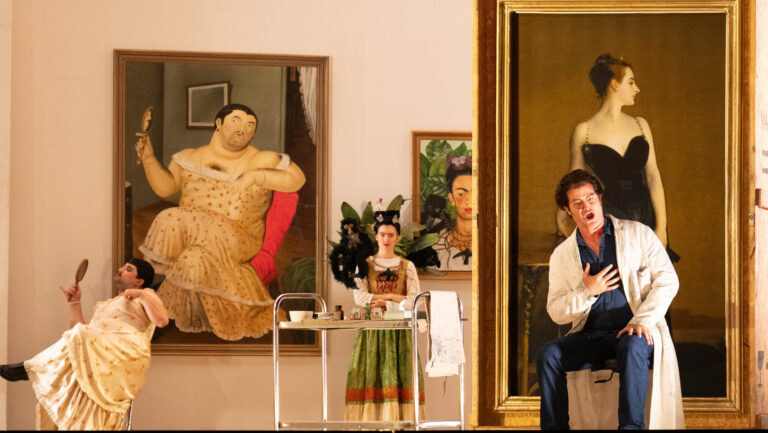
The production at Opera Philadelphia, created by the distinguished Italian theatrical director Damiano Michieletto (though staged here by Eleonora Gravagnola) reframes the piece with a new story. Set in an art gallery in what is presumably the present, celebrated works by Velázquez, Sargent, Haring and others springing to life. Hilarity, as they say, ensues: Michieletto’s staging pushes much of the action into antic farce.

It’s difficult to describe it in more detail—at least it is for me. Try to apply logic to the plot and it sinks faster than the Titanic. I will say, though, that while I couldn’t really follow it, there are many delightful moments, and the audience seemed entranced. For those who, like me, are generally farce-averse, I’ll recommend patience. It will pay off in the final Act, where things come together including a closing image that is a true coup de théâtre.
And of course, there’s the music. On that level, Opera Philadelphia scores major points.
Before we get to the large and very strong cast, let’s acknowledge that the evening’s biggest triumph belongs to Maestro Corrado Rovaris and the orchestra. Rossini—especially obscure and long Rossini (Viaggio is both) needs rhythmic vivacity, virtuoso playing, forward momentum, and the ability to bind a collection of numbers into a cohesive whole. All this it has… and more.
Still, even with a wizard like Rovaris at the helm, a “cohesive whole” is something Viaggio probably never was and never will be. It’s best appreciated as a collection of opportunities for gifted singers to make an impression. There’s nothing here to resemble Figaro’s “Largo al factotum” or Cenerentola’s “Non piu mesta”—genius writing that defines character and moves the plot. What Viaggio has is Rossinian bravura: fizzy, showy moments. As opera lovers know, of such stuff, stars can be made. For me, there were several singers who qualify.
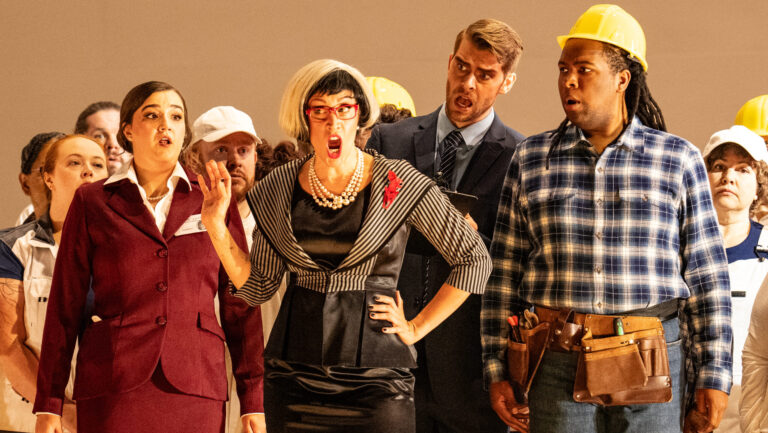
Among the rising divas, three especially stood out for me. First, Lindsey Reynolds (Contessa di Folleville) was alive to every comic nuance of the role and wielded her sparkling high soprano with precision and dazzle. Emilie Kealani(Corinna) brought exquisite purity and musicality to her opera-crowning final solo, and she’s also a charming stage presence. Katherine Beck (Marchesa Melibea) possesses a creamy mezzo with an easy upper register, and a magisterial sense of stage presence that could be felt even in the quieter moments.
Others did well too, including Brenda Rae (Madama Cortese), who again displayed the ravishingly soft top notes that were such a knockout in Opera Philadelphia’s Tancredi nearly a decade ago. Tenor Alasdair Kent (Conte di Libenskof) copes well with fiendishly difficult and high-lying writing and acts with flair. Bass-baritone Ben Brady (Don Profondo) and bass Scott Conner (Lord Sidney) also brought distinguished voices and strong theatrical instincts to their roles. Truly, there wasn’t a weak link in this ensemble of seventeen soloists.
So that’s Opera Philadelphia’s Viaggio in a nutshell. Hyperactive, confusing, and distracting from (and sometimes for) the singers? Yes. Imaginative, wildly entertaining, and musically rewarding? Absolutely.
It occurs to me that this production really is a simulacrum for Anthony Roth Costanzo’s leadership. Since the seemingly indefatigable singer/actor/now artistic director has taken the reins, his high-energy presence is visible everywhere—both off the stage and on. (He’s personally introduced every Opera Philadelphia event and performance I’ve seen since he came, including this one.) ARC, as he’s universally known, can be… well, a lot. But so far, when it comes to building the company and a loyal following, he seems like lightning in a bottle.
Categories: Criticism, Music, PARTERRE BOX, Philadelphia


 reclining standards