The program for Galilee, 34, a world premiere at South Coast Repertory in Costa Mesa, California, includes a conversation between playwright Eleanor Burgess and religious scholar Reza Aslan. In the interview, Aslan points out that genuine prophets don’t set out to found new religions – instead, they work to reform existing traditions. The establishment of faith traditions based on their teachings usually comes after their deaths.
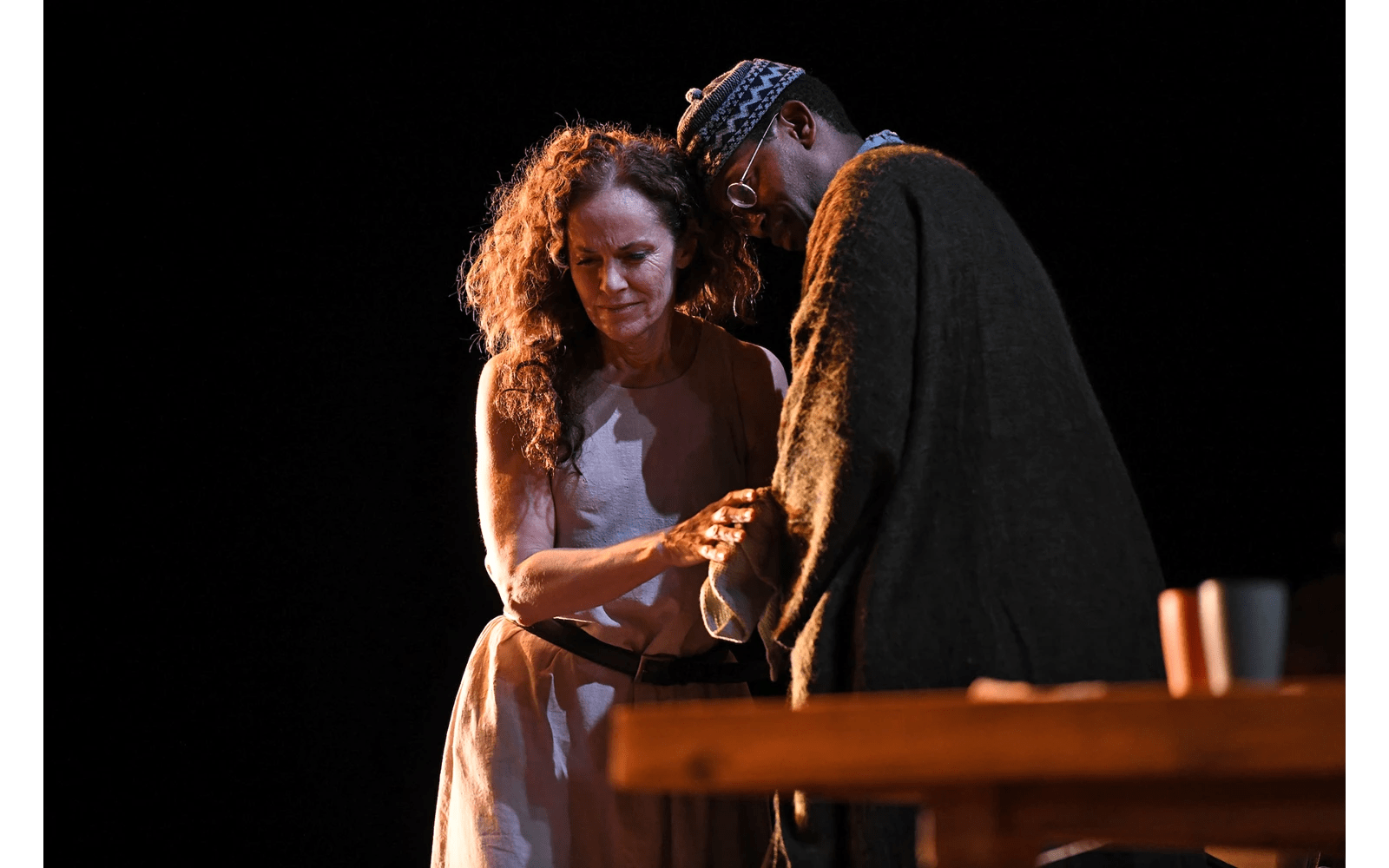
Burgess uses this perspective as the grounding for her insightful and moving play. Set in the year following the crucifixion of Jesus – here called by the Hebrew name Yeshua – the action follows a collection of his disciples as they attempt to spread his message and preserve his philosophy for posterity. The group includes his mother Miriam (Amy Brenneman), a fierce woman unmoored by her son’s violent death; his brother Yacov (Eric Berryman), who still lives in his sibling’s shadow; his partner Miri (Teresa Avia Lim), who chafes at the subjugated position of women in her society; and his best friend Shimon (Benjamin Pelteson), who fears himself an improper shepherd of Yeshua’s message.
In the courtyard of a shabby compound in the middle of the desert – designed by Sandra Goldmark and lit with harrowing chiaroscuro contrasts by Josh Epstein – the group bicker and mourn. They disagree over how the gospel should be spread, and to whom. Into the mix comes Saul of Tarsus (Raviv Ullman), the first genuine convert to Yeshua’s teaching, who uses his education and social standing to further the creation of what could be called modern Christianity. But he soon clashes with the headstrong Miriam, who views herself as the rightful inheritor of her first-born’s legacy.

Burgess doesn’t bog her script down with dogma – above all, she is interested in character study, and the play succeeds best when she focuses on the intimate and sometimes fraught interactions between the characters. Occasionally, tonal shifts between boulevard comedy and intense family drama can feel a little forced, but Davis McCallum’s finely acted production hits the right notes even when the script feels a tad arch. The strong cast also includes Sharon Omi as Elishiva, the mother of John the Baptist, who trenchantly points out that her son’s earlier persecution should have set Yeshua straight.
Lim’s Miri – a.k.a. Mary Magdalene – serves as the audience’s surrogate and interlocutor, pointing out the ways that history has misinterpreted the truth of Jesus’s life. (Turns out she was a wealthy divorcée who gave up her fortune to follow Jesus, not a sex worker – translation error, natch.) Burgess includes just the right amount of direct-address narration to add a bit of cheek to the proceedings, while still keeping the focus squarely on how the characters relate to each other.
Brenneman crafts a portrait of Miriam as a ferocious yet world-weary woman, cut down at the knees by personal loss and Roman occupation. She can land a hilarious zinger one moment – she is a Jewish mother, after all – and then break your heart the next. As her chief adversary, Ullman magnificently balances genuine religious fervor and hard-to-shake arrogance, and their confrontations drip with a combination of resentment and grudging respect.
As the characters seek to synthesize Yeshua’s messages, they often face the problem of interpretation. Case in point: If the Messiah is meant to facilitate a “lasting peace,” does that mean peace in the personal or universal sense? It’s a question, the play suggests, that still doesn’t have an answer. At its best, Galilee, 34 shows why such questions are still asked.

Photographs by Robert Husky.


 reclining standards