
Surely it was lightning in a bottle. The announcement that Steve Carell would appear at Lincoln Center’s Beaumont Theater playing the titular Uncle Vanya in Chekhov’s classic play would, of course, be a box office windfall.
More to the point, it seems like an inspired fit. Vanya is a good man with a deep, compassionate heart. He’s also irascible, sarcastic, indolent: his own worst enemy. This odd bundle of traits is very much in sync with Carell’s comic persona.
At the same time, the idea is an intriguing stretch. Vanya is one of the great theatrical roles—and a challenge for any actor. For Carell—still known primarily from TV and films—to take it on at the prestigious Lincoln Center venue is at once humble and ballsy. It implies a desire to expand audiences’ sense of him.
Anyway, that’s what I hoped for. In practice, the result is more dispiriting.
Directed by Lila Neugebauer and featuring a new translation/adaptation by Heidi Schreck, this Uncle Vanya isn’t so much Carell and company stepping up to a new challenge as refashioning Chekhov’s play into a Steve Carell movie.
Theatrically speaking, that’s the mountain coming to Mohammed… with predictably mixed results.
Before we get there, a bit about Chekhov’s Uncle Vanya. Though it’s the second of what would become his four canonical (indeed, theater-changing) plays—preceded by The Seagull, and followed by Three Sisters and The Cherry Orchard—its roots are earlier, as a reworking of The Wood Demon. Certainly many of the playwright’s core qualities and themes are deeply ingrained already here.
We are on a large country estate, owned by the distinguished, successful, pompous professor Alexander Serebryakov, who is here with his young and beautiful second wife, Elena. (I’m using here the transliterated names in this version.) Others are staying on the estate, including Sonia (Alexander’s daughter) and Vanya (Alexander’s brother-in-law: his late first wife was Vanya’s sister). Astrov, a local doctor, lives here too, and shares frequent, mordant conversations with Vanya.

The surface plot involves details about the future of the estate and its management. Ultimately, though, what matters more is the intertwined lives of its central characters. There is love and loyalty among them, but in this fishbowl world resentments and complications grow, including romantic ones. Sonia loves Astrov. Astrov loves Elena. Elena loves Astrov… but is, of course, married to Alexander. Vanya also loves Elena from afar, but in a sense is an observer here, and in both mood and circumstance most closely bonded to his niece, Sonia. For them, life moves on, but seemingly with only limited possibilities.
Chekhov famously considered at least some of his plays “comedies,” and Uncle Vanya certainly has a farcical overlay in its structure: A is in love with B who is in love with C, and so on.
But—this is always rooted in a deep sense of pathos and yearning: laughing through tears is a way of life. Look up the term “Chekhovian,” and you’ll see for yourself!
At Lincoln Center, Chekhov’s plot remains, and in fact Schreck’s translation—comfortably colloquial but cannily evading anything specifically contemporary—might still work in a period setting (the play was first produced in 1899). But Neugebauer and especially costume designer Kaye Voyce make it clear that this is happening in a contemporary world.
More jarringly, the acting style across the board has a loose, often hipsterish hint of snark. While it registers the sort of incurable ennui that lies at the heart of Chekhov’s play—a group of people who are destined to be in each other’s company but mostly failing to connect in any happy sense—the humor, especially in the first scenes, is overplayed—and for me, this Uncle Vanya never recovers.
For all the time shifting and novelty, it also suffers from another common weak link in Chekhov productions: the absence of a cohesive theatrical style. These characters may be disparate, but they form a community and are part of the same milieu; here, even family members seem to come from entirely worlds.

As the pedantic Alexander, Alfred Molina brings a scale and brio that would work well in a traditional staging; but it feels a bit odd here. At the other end of the spectrum, William Jackson Harper very imaginatively invests Astrov with a droll modern spin, but it reduces the character’s deeper and more appealing traits.
Anika Noni Rose is more effective suggesting Yelena’s glamour and hauteur than the passion that underlies it. It’s the opposite situation for Alison Pill as Sonia. This wonderful actress here is constantly febrile, frequently dissolving into tears. The great pathos of Sonia is her heartbreaking invisibility. That quality would be more effectively conveyed through quiet acceptance of her dreary future.
And then, of course, there’s Steve Carell’s Vanya. He is a comfortable stage actor, running the gauntlet here from clowning to rage to grief. To me, though, it looks like an impressive display of skills from the actor’s toolkit. An audience is surely meant to find Vanya beyond exasperating, but I think we also need to love him. Frankly, I can’t get past Carell’s smugness.
Given this production’s comedic slant, it’s no surprise that two actors in small and funny supporting parts come off best. Mia Katigbak (as Marina, an elderly family nurse) and Jonathan Hadary (Waffles, a sort of loony hanger-on) are unfailingly delightful.
It’s no surprise either that director Lila Neugebauer hasn’t fused this into a cohesive universe or an emotionally compelling one. Staged on Mimi Lien’s deliberately spare set, the visual world is picturesque but rarely more than that.
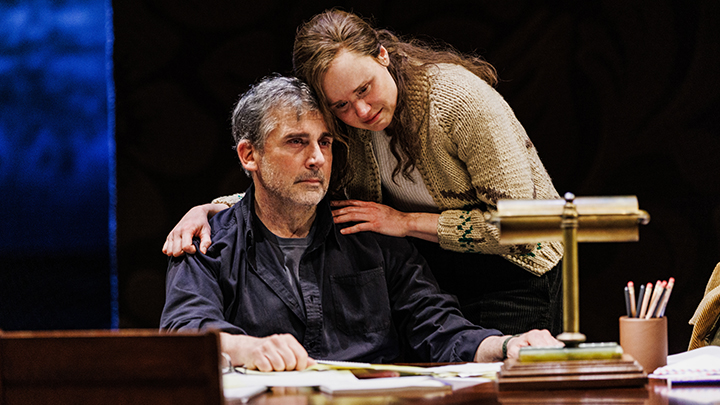
The vastness of the Vivian Beaumont Theater is another issue—it’s an unfavorite space of mine, one that can work for musicals but rarely for plays. Surely this is a big part of the problem here, I thought.
Yet hours later, I remembered having seen Chekhov’s Ivanov here almost 30 years ago. That production, directed by the late Gerald Gutierrez and featuring Kevin Kline and a quite starry ensemble, is the best American production of a Chekhov play I’ve ever seen.
The difference, I think, is that Gutierrez and company weren’t working so hard to put a new spin on the play. Instead, their production lived in Chekhov’s world—and both comedy and tragedy (and the delicate balance between) came through more clearly.
Photos by Marc J. Franklin
Categories: Criticism, General Ramblings, Theater


 reclining standards