Tommy, can you hear me? The audience can certainly hear The Who’s Tommy in the overamplified but underpowered revival that opened recently on Broadway at the Nederlander Theatre. Blaring orchestrations and mealy-mouthed singing eclipse the musical’s best feature—the frequently ingenious rock-and-roll score by Pete Townshend—and the threadbare plot remains hard to follow in a new production directed, like the original, by Des McAnuff. The overall effect is that of a second-rate performance by a third-rate cover band, the kind that occasionally reveals the brilliance of its material but more often feels like reheated nostalgia.
Ticket-buyers who grew up on The Who’s 1969 “rock opera” studio album probably don’t care about the work’s dramaturgical messiness, but McAnuff and choreographer Lorin Lotarro seem to go out of their way to obscure any semblance of a perceivable plot. The title character, struck deaf, dumb and blind after witnessing his father shoot his mother’s lover, regains his senses—along with a cultish celebrity status—after becoming a teenage pinball prodigy. Tommy’s upbringing takes place amid the bland coziness of life in post-war England, where darker elements lurk beneath the polite social surface. (Tommy is molested by an uncle and taken by his father to a drug-addicted sex worker.) Townshend’s songs perfectly capture this divide and the brittle world from which Tommy escapes into himself.
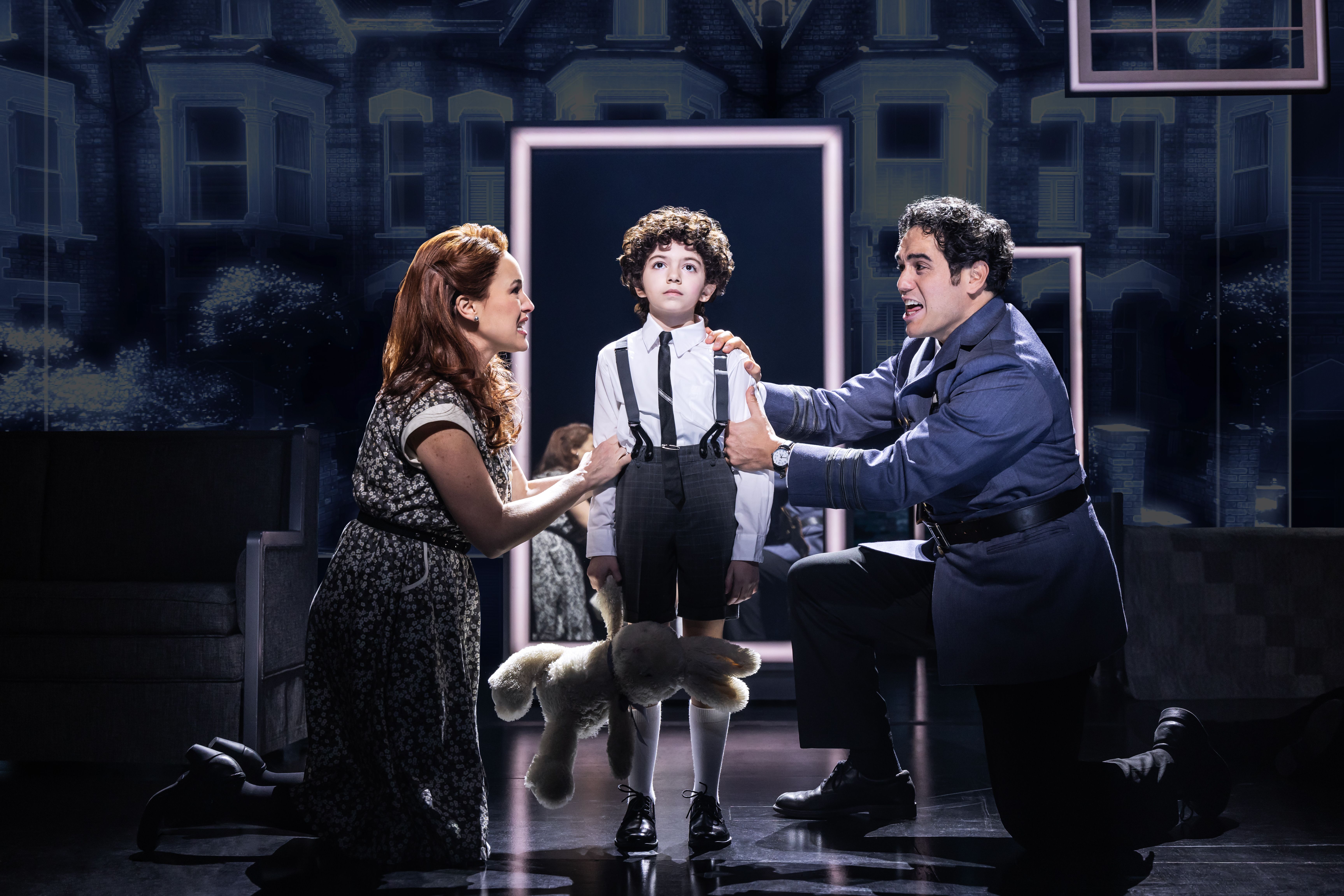
The musical itself functions as something of an extended dance piece that occurs with the score performed in the background. Lotarro’s choreography, however, is artless and difficult to follow, with masses of bodies heaving themselves around the stage in black, reminiscent more of a postmodern dystopia than a recognizable society. The scenery by David Korins) consists largely of bland scaffolding; projections (by Peter Nigrini) fill out the design in a garish manner. There are occasional thrilling moments—as when 10-year-old Tommy (played at the performance I attended by Reese Levine, who alternates with Quinten Kusheba) first steps up to a pinball machine, or when the Acid Queen (Christina Sajous, rich-voiced but otherwise nondescript) is hoisted up in the air as she drifts into an all-consuming high—but the total effect is confounding and confusing.
The show’s libretto (crafted by Townshend and McAnuff) doesn’t leave much room for character development, although Adam Jacobs and Alison Luff are both curiously bland by any standard. Ali Louis Bourzgui cuts a distinctive figure as the adult Tommy, with a mop of black curls and solid-color turtlenecks (costumes by Sarafina Bush), but his Broadway baritone sounds slightly awkward in music that is really meant for a rock tenor. John Ambrosino is too self-consciously creepy as the pedophile Uncle Ernie, and Bobby Conte lacks menace as Tommy’s manipulative Cousin Kevin. The ensemble traverses various levels of loudness.
This staging originated last summer at the Goodman Theatre in Chicago, where it broke house records and was quickly marked for a transfer. It’s easy to imagine why this was viewed as a viable Broadway prospect, but the finished product comes across like a solid regional offering at best. In one of the show’s most famous numbers, Tommy sings a simple refrain: “See me, feel me, touch me, heal me.” There is lots to see in this Tommy, but little to feel.
PHOTO CREDIT: Matthew Murphy and Evan Zimmerman


 reclining standards