
CAMERON KELSALL: Nearly 80 years after its debut, A Streetcar Named Desire remains an unimpeachable play. It withstands whatever directorial intervention or actor’s interpretative choice comes its way. And it certainly faces plenty in the production directed by Rebecca Frecknall, which originated at London’s Almeida Theatre and is now onstage at the Brooklyn Academy of Music.
Frecknall’s vision includes contemporary dress and scant set design, an onstage drummer, weather effects (the Brits love their onstage rain), and a compunction to keep the company hugging the rafters to overlay a sense of voyeuristic invasion on the proceedings. The actors, led by Paul Mescal and Patsy Ferran, are less poetic and more brutal than I’ve ever seen. As a Tennessee Williams worshipper, my first instinct was to sniff at some of these choices, but within the world that Frecknall creates, I find they mostly work. This Streetcar is a gripping realization that makes new a play many of us feel we know inside out.
DAVID FOX: To me, one of the hallmarks of a great play is that it not only withstands directorial reimagings, but it can yield new discoveries. Reading your comments above, I agree with both your implied criticism of some aspects of Frecknall’s reboot, and your conclusion that it makes us think anew about Streetcar. I’ll begin with some advice for those who will see it: banish your memories of Vivien Leigh and Marlon Brando on film, in what must certainly be one of the greatest film adaptations that ever has or will happen.

CK: I imagine some viewers with a deep knowledge of this play and its performance history will be cool toward Ferran’s more frenetic approach to Blanche. She does away with the wistful and romantic conception of the character, the sense that her courtliness and sensitivity are what make her unsuited to living in the harsh light of day. Ferran’s speaking voice, high-pitched and occasionally cloying, betrays little sense of lyricism for sure.
But I found her take on the role wholly persuasive, especially if you consider the character as someone hurtling toward a mental breakdown. She’s not lost in reverie; she’s dancing as fast as she can. I was particularly struck by Ferran’s almost violent emotion in the scene where she recounts to her suitor Mitch (the consistently superb Dwane Walcott) the details of her husband’s death. Her matter-of-fact anger and revulsion at his implied homosexuality is jarring and effective.
DF: I absolutely agree with this—Ferran is the most decisively different aspect in Frecknall’s interpretation. For me, it works on its own terms, but it’s likely to be the most polarizing. Which is interesting, given that (here in the U. S., at least) the marquee name, and what is likely to drive the box office, is Mescal as Stanley. My own take is that while he’s excellent, his Stanley significantly recedes into the background. Mescal can be a real presence, but here he dials down the magnetism and sheer brute force of Stanley, who registers instead as a secondary character, important, but ultimately not center-stage. Which I rather think is what Williams may have originally intended… until Marlon Brando swept in, and essentially changed everything.
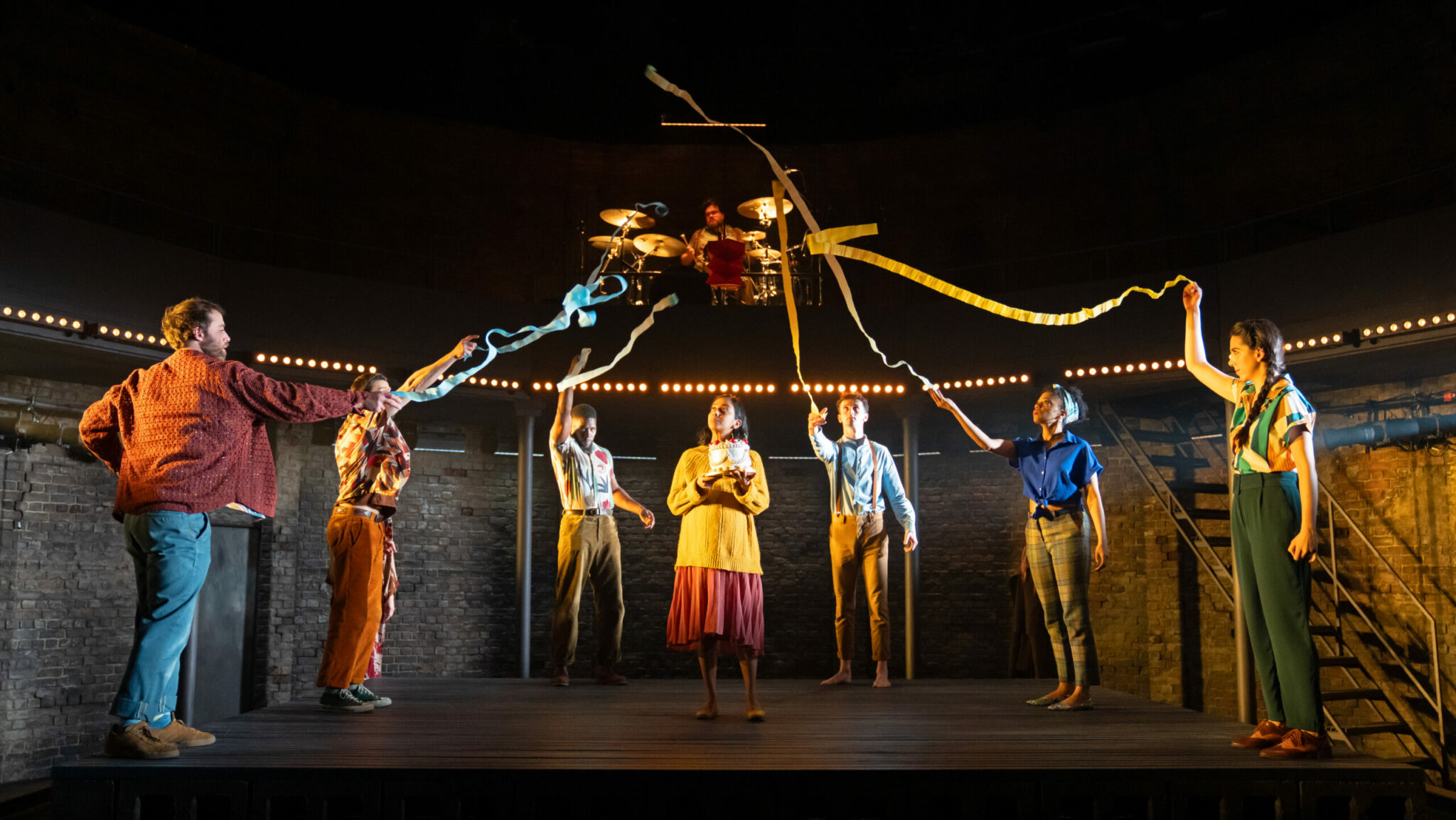
DF: I agree that the sense of group observation is a major takeaway here. While I was watching it, I thought of the infamous Kitty Genovese case, where the collective takeaway (not entirely true, but the way it was viewed) was that people observing it did nothing to stop it. It’s worth considering what it might mean that this Streetcar has a female director. I certainly did come away with the sense that Blanche was fundamentally doomed from the beginning—all societal factors were working against her. I found this perhaps the production’s most powerful takeaway. (And far more persuasive to me than the last British Streetcar I saw – Benedict Andrews’s ghastly version where Blanche is a shrewish nutcase from the start.)
CK: That strikes me as a fair reading of Frecknall’s overarching vision, and one that’s borne out again in the production’s final image, as Stella collapses into Stanley’s arms after Blanche has been taken away to the sanitarium. Kazan’s film adaptation appliqués a feminist coda here—Stella pushes Stanley off, telling him to never touch her again—but Williams, and Frecknall, recognize that she is herself in a cycle of attraction and abuse. Of course she’s not going anywhere; what other options would she have? It concludes the staging on a striking, disturbing note. It also helps make sense of the slightly muted performance Anjana Vasan gives as Stella—she’s resigned to her situation, rather than the willing participant she claims to be.
DF: There’s more we could explore: Frecknall’s use of almost balletic, stylized body movement, for example, which I found distracting and out of place. But I think the main point here is that on balance, it’s a powerful, provocative staging that deserves to be seen.
CK: If you can get a ticket, that is—the production, which runs through April 6, is virtually sold out. But it’s worth the trek to Brooklyn to experience a classic born anew, and Streetcar is always a rewarding ride in its own right.
Photo credit: Julieta Cervantes
Categories: Criticism, New York, PARTERRE BOX, Theater


 reclining standards