
Audiences on West 44th Street in search of a show about a driven mother who will do anything to put her daughters in show business in service of fulfilling her own dreams will soon find their options doubled. In November, Broadway’s next revival of Gypsy will open at the Majestic Theatre. Meanwhile, just steps away at the Broadhurst Theatre, Jez Butterworth’s The Hills of California holds the stage.
These are, to be fair, two very different works. Gypsy is, of course, a (maybe the) classic musical, and in many ways a quintessentially American story, surveying decades when vaudeville went into a permanent eclipse. The Hills of California is set in Blackpool, an English coastal town, in two time frames 20 years apart: 1956 and 1976. And though Hills is anchored by a few familiar songs, charmingly though deliberately amateurishly performed, it is notably a play.
I suppose some plot summary is helpful, but I’ll make it minimal. In a Britain still feeling the aftereffects of World War II, Veronica is operating a rather sad seaside hotel, and living with her four daughters: Gloria, Jill, Ruby, and Joan. What has become of the husband and father is an ever-changing story, which mostly casts him heroically as a fallen soldier.
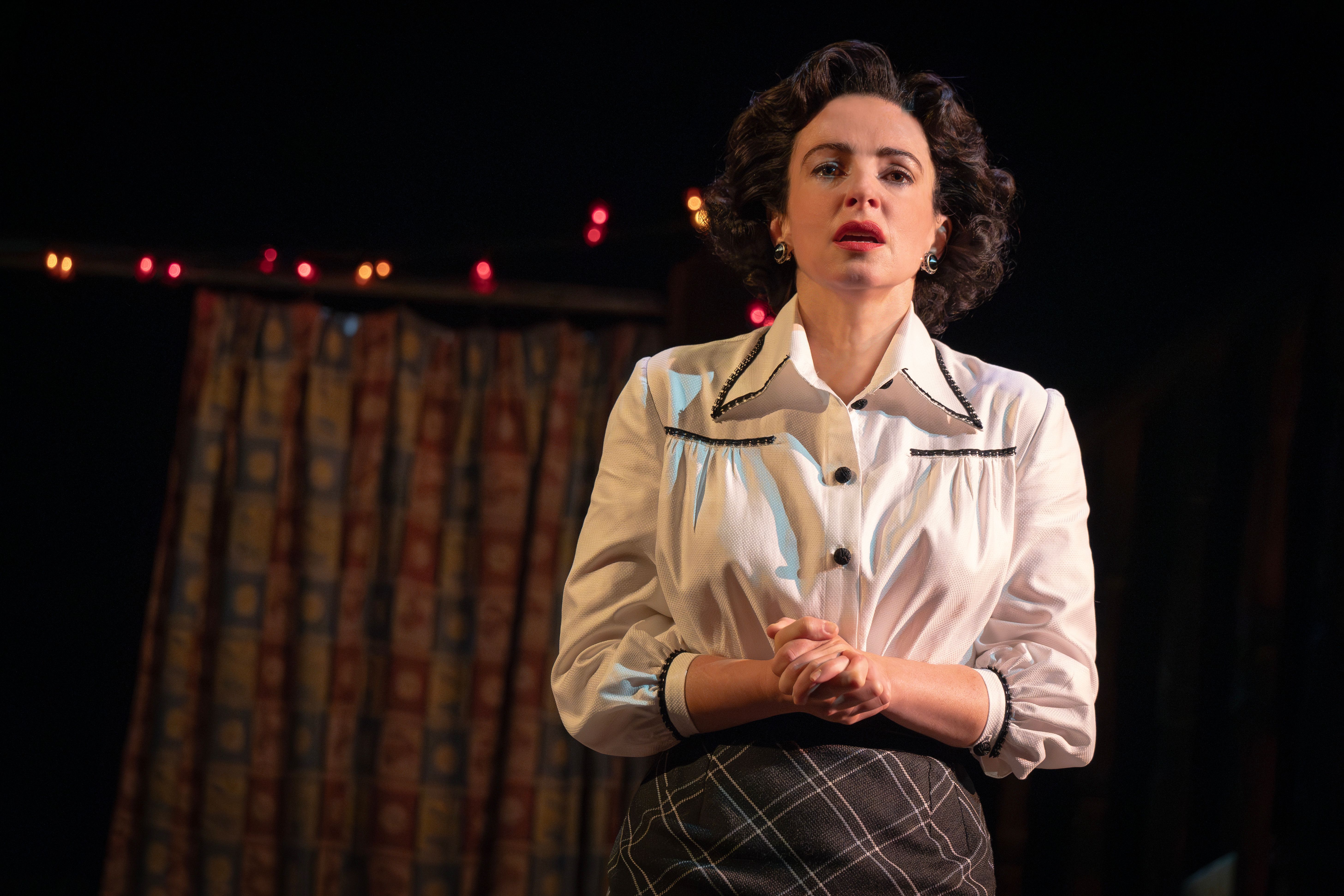
The four daughters want—or perhaps it’s more accurate to say Veronica wants for them—musical stardom as a singing group in the tradition of the Andrews Sisters. That by 1956, musical styles have moved on is indeed part of the equation. When Veronica is gently asked about Elvis Presley, she seems not to know who he is (an improbable moment in Butterworth’s play, and not the only one).
The focus in The Hills of California, though, is less on evolving cultural history than on families—hopes, dreams, and the fraught ways in which they rarely intersect with reality.
Here, as in his previous plays Jerusalem and The Ferryman, Butterworth is masterful at telling small stories in a big, bold format. He can orchestrate large conversations and intimate ones, and move seamless between them.
But The Hills of California is an altogether gentler work than those—and lacking the feral intensity, Butterworth doesn’t have a firm grasp on what he wants to say.
Much of the action is segmented, and falls into archetypal situations that will remind you of others we’ve seen before: a gloves-off reckoning among sisters as their mother lies dying upstairs; earlier, that mother living through her daughters’ achievements; etc. Here, the playwright rarely breathes new life into these moments.
There is for me a built-in compromise in The Hills of California. While Butterworth seems intent on shining a harsh light on the idea of nostalgia, his play also wants to bask in it. The Broadway audience certainly does—every musical strain and reference to a distant cultural past is oohed and aahed-over.

There is also clear pleasure taken in the top-shelf Britishness of this enterprise, imported from the U.K. It’s directed with customary magisterial authority by Sam Mendes, and designed with ghostly, decaying beauty by Rob Howell and Natasha Chivers. The cast, virtually intact from the West End, is fine across the board, with especially good work from Ophelia Lovibond, who also sings charmingly.
Still, none of them registers as strongly as they might. The standout performance here is Laura Donnelly, though even that is equivocal. As Veronica, she’s astonishing in her barely suppressed ferocity. Watching Donnelly’s face in a climactic moment that ends Act II (with another act to come) is a textbook acting lesson. Yet playing Joan in Act III (yes, it’s a coupe-de-théâtre to have the same actress in mother and daughter roles), Donnelly feels less dimensional.
Again, Butterworth bears much of the responsibility. As with the situations, the characters often feel like distillations we’ve seen before. For me, the play’s main interest lies in his treatment of (spoiler alert) Joan’s embrace of a show business career that leaves her family and Blackpool behind. This has an intriguing ambiguity—yet it too ultimately doesn’t satisfy.
As noted, the audience appeared to adore every moment of The Hills of California, but I didn’t share the enthusiasm. I’ll certainly look forward to another Jez Butterworth play—The Ferryman and Jerusalem absolutely knocked me out.
Till then, look for me in November at Gypsy.
Photos by Joan Marcus


 reclining standards