It was a matter of chance that I should have rented a house in one of the strangest communities in North America. It was on that slender riotous island which extends itself due east of New York—and where there are, among other natural curiosities, two unusual formations of land. Twenty miles from the city a pair of enormous eggs, identical in contour and separated only by a courtesy bay, jut out into the most domesticated body of salt water in the Western hemisphere, the great wet barnyard of Long Island Sound.
_________
If personality is an unbroken series of successful gestures, then there was something gorgeous about him, some heightened sensitivity to the promises of life, as if he were related to one of those intricate machines that register earthquakes ten thousand miles away. This responsiveness had nothing to do with that flabby impressionability which is dignified under the name of the “creative temperament”—it was an extraordinary gift for hope, a romantic readiness such as I have never found in any other person and which it is not likely I shall ever find again.
_________
They were careless people, Tom and Daisy—they smashed up things and creatures and then retreated back into their money or their vast carelessness, or whatever it was that kept them together, and let other people clean up the mess they had made…
_________
Three quotations above are likely to be familiar to many, but just in case: they are from F. Scott Fitzgerald’s The Great Gatsby, often cited as among the greatest American novels, and which—having been written in 1925—has now entered the public domain.
Today it can be adapted by… well, pretty much anybody. For better or worse.
Back to those quotes. The first captures a picturesque peninsula landscape where a pair of shore towns bring communities of haves and have-nots together in an uneasy standoff. The second is, of course, a snapshot of the charismatic, enigmatic Jay Gatsby himself… about whom we never know quite enough. The final sentence, famous and often quoted, captures not merely Tom and Daisy and their quirks, but a tragic moral vacuum that defined American privilege in the 1920s.
All of this is to say that while a lot of things happen in The Great Gatsby, it’s not the plot that keeps us fascinated. It’s Fitzgerald’s prose (provided in the book by the sometimes besotted but also clear-eyed narrator, Nick Carraway), at once spare and luminous. Perhaps even more, it’s his penetrating, sometimes devastating character analysis, and the metaphoric sense he captures of something bigger and awful in the national zeitgeist.
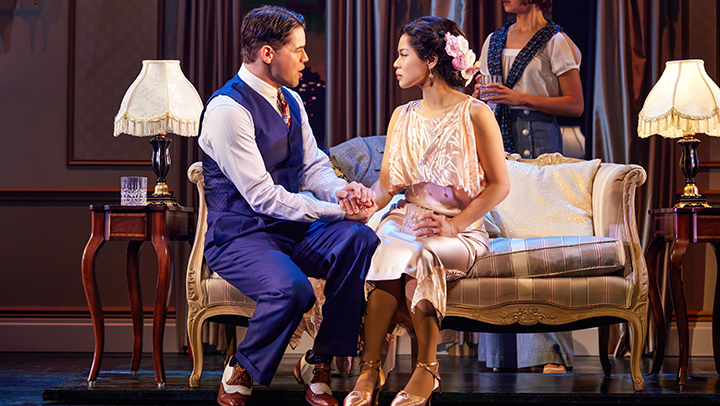
Yet when it comes to a new musical adaptation of The Great Gatsby (book by Kait Kerrigan, lyrics by Nathan Tysen, music by Jason Howland) now on view at the Paper Mill Playhouse, it’s little but the plot that remains. Actions and events are generally rendered faithfully—but the tone is unrecognizable. Imagine if Gatsby had been written by Sidney Sheldon or Judith Krantz and you’ll have some idea.
So, Nick’s narration is reduced to doggerel like “Acres of gardens stretch to the sea / Who can afford this type of luxury? / And could that person ever be me?” Key characters like Tom, Jordan, George and Myrtle Wilson, and Meyer Wolfsheim register only as types.
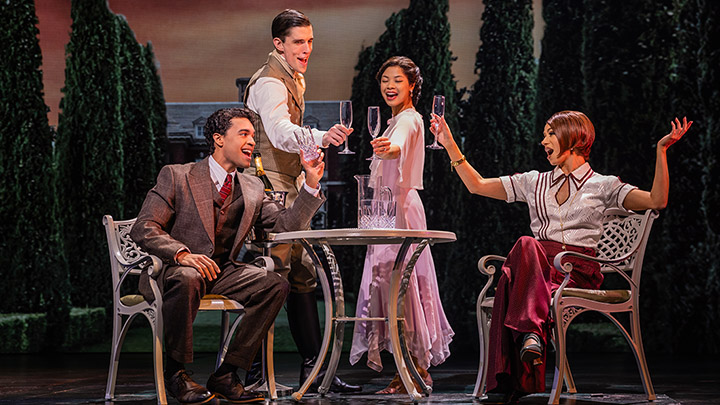
The first act is largely framed through glittery Roaring 20s excess—the champagne flows, the gaudy world—lots of projections and moving scenery by Paul Tate dePoo III—looks like Rockefeller Center as it might be painted by Thomas Kinkade, and a manic ensemble stares at the audience while dancing, and singing: “We live for today, we pay off the cops / And when you think the party stops / The party’s roaring on / Oh, we beat on and on and on and on and on and on and on.” (The score has some pleasant tunes and occasionally gestures at 1920s style, but mostly sounds contemporary.)
There’s a turn in Act II, of course. Here, the decline and impending doom are rendered for maximum melodramatic excess (again, think Sidney Sheldon). By the time we get to the end—where more of Fitzgerald’s language is incorporated—it’s too late. The show has capsized in a huge, showy heap.
If I told you that Fitzgerald’s shattering apotheosis—the car accident that kills poor, benighted Myrtle—is proceeded by an 11 o’clock number called “One-Way Road,” you probably would think I’m joking. Alas, no. In this vulgar world, there is no situation that can’t be limned with a power ballad.
Ah, yes: those power ballads. So, here’s the thing. Most likely, none of this matters to the target audience. Remaining performances are all but sold out. The night I saw Gatsby, the house was packed, the visibly delighted audience cheering.
They are here, I’m sure, for Jeremy Jordan (Gatsby) and Eva Noblezada (Daisy).
These two celebrities in the world of contemporary musical theater are likeable performers with awesome singing voices, whose skill at navigating showy Big Numbers is off the charts. On this level—and this level alone—Gatsby delivers the goods. The songs aren’t deathless or even in many cases particularly memorable, but they are cannily structured in the sweet spot of these singers and give them opportunities to shine.
For Jordan, this includes regular forays into a sweet falsetto, transitioning into a tidal wave belt. For me, this makes him sound weirdly like Roy Orbison, but never mind. Noblezada can similarly move from sweetness to power in the arc of a single line, and again the songs play to her strengths.

Neither of them is quite right for their characters. Jordan bears a vague resemblance to the Marlon Brando of On the Waterfront and has some of that almost childlike vulnerability. But he planes off the rough edges (Gatsby is, among other things, a gangster) and the mystery. Noblezada also lacks mystery, and too often seems merely petulant. To be fair to them, the book and lyrics give them very little depth to work with.
As I said, this may not matter. If you want to hear two significant theater singers in peak condition giving generously of their talents, this Gatsby will give it to you.
For me, before I’d willingly see this show again, I’d stand in the middle of a One-Way Road in Long Island and wait to be run over.
Categories: Criticism, PARTERRE BOX, Theater


 reclining standards